
Mukesh Pandey
First-Principles Thinker
Origin Story
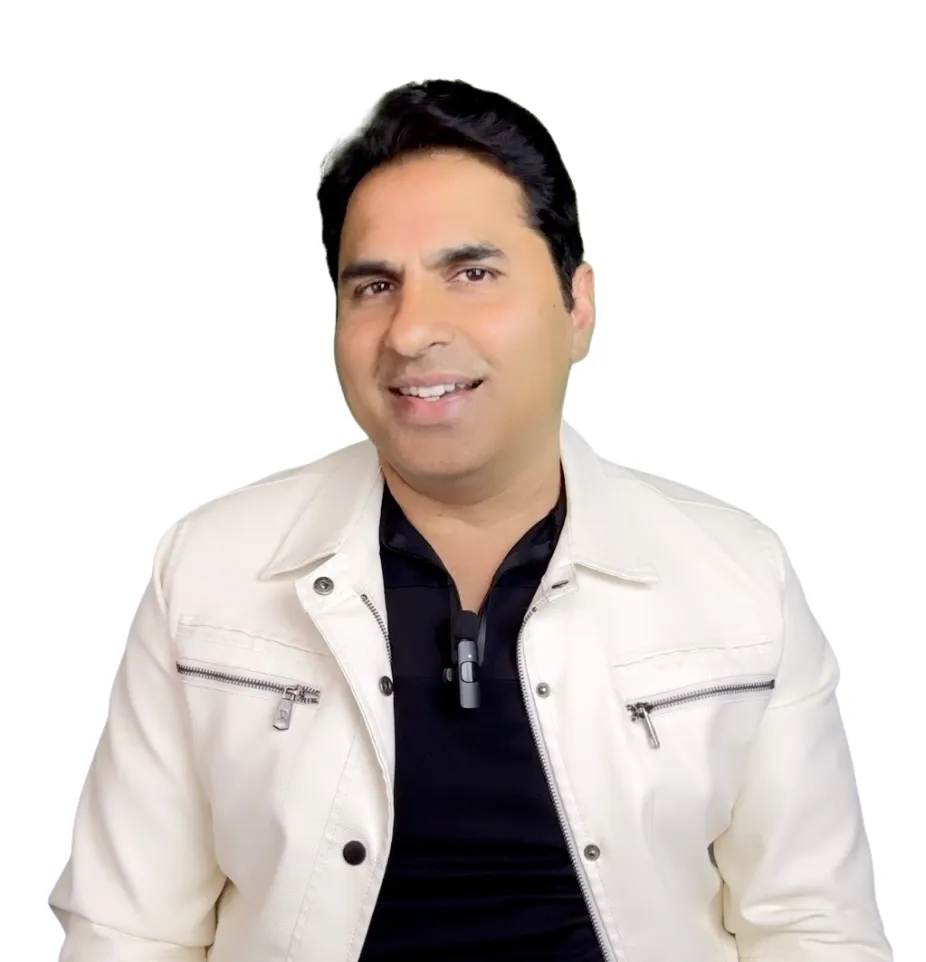
Mukesh Pandey is a first-principles thinker, technologist, entrepreneur, educator, and longtime explorer of health, human potential, and consciousness.
His interest in health did not begin as a medical specialization.
It emerged alongside decades of inquiry into how humans understand complex problems, how we represent reality, and how the tools we use shape the actions we take.
Trained as an engineer, Mukesh has spent more than two decades solving complex problems with leading technology companies, including Amazon and Google, as well as numerous Fortune 500 organizations. His work has spanned cloud computing, big data, machine learning, artificial intelligence, blockchain, Web3, Generative AI, and Agentic AI.
Mukesh graduated in Mechanical Engineering from the Indian Institute of Technology (IIT) Kharagpur, one of India's premier engineering institutions. He was recognized early for academic excellence, winning national STEM talent competitions in India, and later broadened his perspective through executive education and coursework at Harvard, MIT, and Berkeley.
He began his career in enterprise technology with companies including Oracle and Cisco before moving toward emerging technologies and large-scale consumer platforms. Over the years, he has trained thousands of professionals from Fortune 500 organizations in cloud computing, big data, and artificial intelligence, including board members, C-suite executives, distinguished engineers, architects, developers, data professionals, and technical teams worldwide. His contributions have also been recognized by Amazon.
Alongside his technology career, Mukesh has been an entrepreneur, founding multiple technology startups. One of his companies was recognized by Inc. 500. His entrepreneurial journey has given him firsthand experience with building companies, fundraising, mergers and acquisitions, and IPO-related initiatives.
But running alongside this outward journey has been a longstanding interest in health, wellness, meditation, and human potential.
Over time, Mukesh became increasingly interested not only in different approaches to health, but in a more fundamental question:
What are we actually trying to accomplish when we heal?
Modern healthcare offers extraordinary capabilities.
Other traditions and approaches may look at the human through different perspectives.
Nutrition, movement, meditation, technology, measurement, and lifestyle can introduce still others.
Each may reveal something.
Each may provide tools.
But beginning with the tools creates another problem.
Which tool?
Which modality?
Which measurement?
Which practitioner?
Which approach?
A principle Mukesh had encountered repeatedly in technology and entrepreneurship began to seem equally relevant to health:
Problem before Tools.
Before choosing how to act, understand the problem.
And before even understanding the problem, another question emerged.
What are we acting upon, and what are we acting toward?
We do not have complete access to everything happening within a human being.
We create representations.
Symptoms.
Diagnoses.
Measurements.
Biomarkers.
Medical records.
Wearable data.
Observations.
Experiences.
Together, these can contribute to a representation of where we understand ourselves to be.
Hintegrated calls this the Health State.
But the Health State is not the human.
It is a representation of the human's current reality.
Similarly, healing moves toward something.
Less pain.
Greater mobility.
A particular measurement.
Recovery.
Longevity.
Appearance.
Function.
Or simply greater capacity to participate in life.
These outcomes can contribute to a representation of where we intend to go.
Hintegrated calls this the Health Goal.
But the Health Goal is not healing intent itself.
It is a representation of healing intent.
This led to another principle:
Coherence before Control.
Before asking what treatment, product, practice, technology, or modality to use, first examine the two ends of the healing journey.
Does the Health Goal remain coherent with healing intent?
Does the Health State remain coherent with current reality?
Then ask what kind of problem lies between them.
Not every problem requires the same way of seeing it.
Some problems benefit from a narrow aperture and extraordinary resolution.
Others may require widening the aperture to see relationships and context that a narrower representation leaves out.
Neither is inherently better.
The nature of the problem should help determine the aperture, the resolution, the approach, and ultimately the action.
This changed the meaning of integration.
Integration did not have to mean combining as many modalities as possible.
It could mean something more fundamental:
Keep healing integrated with the human.
The human remains the reality.
Health Goal and Health State are representations.
Actions are chosen in response to the nature of the problem.
Results provide feedback.
And that feedback can cause us to reconsider the action, the Health State, the Health Goal, or all three.
Hintegrated emerged from this inquiry.
It does not begin with allegiance to a particular modality.
Nor does it prescribe what an individual's healing intent should be.
It begins with the human.
Understand the Health Goal.
Understand the Health State.
Understand the problem.
Choose an appropriate action.
Observe what happens.
Learn.
Adapt.
Continue.
Mukesh continues this inquiry through Hintegrated while applying related ideas to consciousness through Goherence, entrepreneurship through Uptinker, and organizational scale through Servlinx.
The work is ongoing.
We are here to explore, experiment, and share notes on keeping healing integrated with the human.

Contact
© Copyright 2026 Hintegrated. All rights reserved